5 Animation Representations in Video Games Worth Knowing About

TL;DR
Game animation shapes everything a player experiences. From 2D sprites to mixed-media cutscenes, there's a lot more going on beneath the surface.
Animation has always been the centre of video games. It has come a long way since the early years of gaming.
Animation invites players to escape into its virtual world. The immersive experience makes every moment feel real.
Animation techniques in video games have changed over time. What started as 2D sprites has grown into 3D models and clay-sculpted NPCs.
Animation plays an important part in modern video games. It brings characters’ movement, interactions, and environments to life. Through techniques such as motion capture, 3D animation, and 2D sprite animations, game developers create imaginary worlds that feel believable. It also enhances storytelling, strengthens the emotional bonds between players and their characters and boosts overall player experiences.
Whether you're an aspiring animator, an animation student, or simply curious about how games come to life, here are 5 instances of animation in video games.
Table of Contents
Why Does Animation Matter in Video Games?
Animation is what creates the immersive experience for players. From details like trees swaying, water flowing through a waterfall, and characters in the background talking and walking, animation adds motion and personality to visual designs.
Most importantly, it also turns static digital assets into interactive spaces that give weight, timing, and responsiveness when playing a game. Whether a character is running, jumping, attacking, or interacting with objects, animation impacts how the game feels.
Over a third of players say animation quality shapes how much they enjoy a game. Moreover, games with strong visual design see higher player retention as a result, with good animation pulling you in and keeping you there to enjoy the experience.
How Does Game Animation Differ from Film Animation?
On the surface, both share the same building blocks—characters, movement, timing—but are designed for different experiences.
In film, animators plan and prepare a fixed sequence, where the audience watches from camera angles that have been determined by the director. This allows control over what it wants to show to the audience, from storytelling and pacing to composition.
Meanwhile, in video games, animation must respond dynamically to the input in real time. Players may want to make their characters run, jump, attack, or change direction at any moment, and animation needs to blend seamlessly. That means game animators build for every possibility.
In short, game animation prioritises interactivity, responsiveness, and player control. While film animation focuses on delivering directed cinematic storytelling.
Animation is not limited to movies or television shows. It’s a form of art that has slipped its way into numerous other forms of entertainment—including video games.
5 Animation Techniques in Video Games Worth Knowing About
1. Procedural Animation – Half-Life 2

Initial release date: November 16th, 2004
Genre: FPS, Action-adventure
Developer: Valve
Ragdoll physics is one of the clearest examples of procedural animation in games. Rather than playing a fixed death sequence, characters in Half-Life 2 collapse based on real-time physics calculations. Each reaction is shaped by force, angle, and environment at that moment.
Procedural animation generates movement through real-time calculations instead of relying on pre-made animations. It helps make motion feel more dynamic and less predictable.
Half-Life 2 became well known for its ragdoll physics system. It lets characters react to the situation in real-time. The results were sometimes exaggerated and even comical, though later updates refined the system — which quickly turned into a source of emergent gameplay and online humour for the players.
2. 2D Sprite Animation – Terraria

Initial release date: May 16th, 2011
Genre: Action-Adventure, Sandbox
Developer: Re-Logic
Terraria is a strong example of 2D sprite animation, one of the most common types of animation in games. From enemies and NPCs to large-scale boss fights, animated sprites bring the game's world to life.
Sprite animation works by running a sequence of pixel art bitmaps to produce the illusion of movement. For example, the Moon Lord is an end-game boss and built from multiple animated sprite components, with each body part moving and attacking independently. The attacks and movement patterns are independently animated to add visual complexity.
The environment also uses sprite animation. Players can see clouds moving across the sky, day-to-night transitions, and lava flowing in underground areas. These layered animations help create an engaging world without relying on 3D models.
3. Keyframe Animation – Shadow of the Colossus

Initial release date: October 18th, 2005
Genre: Action-Adventure, Puzzle
Developers: Team Ico, Sony
As their names suggest, the colossi are monumental in size, some even taller than city buildings. The animation team used keyframe animation to emphasise their immense scale and give each movement a sense of weight and deliberation.
Keyframe animation defines specific poses at set points in time, with the software filling in the movement in between. It is also one of the most widely used animation techniques in game animation today.
The team applied the same thinking to environmental details too. Dust clouds would form around the feet of the colossus as it advanced towards its target; horses would refuse to respond to player commands if it meant heading to danger.
4. Digitised Clay Model Animation – Fallout (1997)

Initial release date: October 10th, 1997
Genre: RPG, Adventure
Developer: Interplay Entertainment
Before motion capture became standard, studios found other ways to bring characters to life. Fallout 1 built its NPC talking heads from physical clay sculptures, modelled by hand, textured in Photoshop, digitised, then animated.
This technique combined traditional sculpture with digital tools, making it a unique example of animation in game development. The process required artists to create physical models before converting them into digital assets.
The technique stands out for its ingenuity in how traditional and digital animation techniques can complement one another. They give the talking heads a warmth and personality that was often missing from fully digital characters of the time.
5. Mixed 2D/3D Cutscene Animation – Jazzpunk
Initial release date: February 14th, 2014
Genre: Art, Indie, Adventure, Comedy
Developer: Necrophone Games
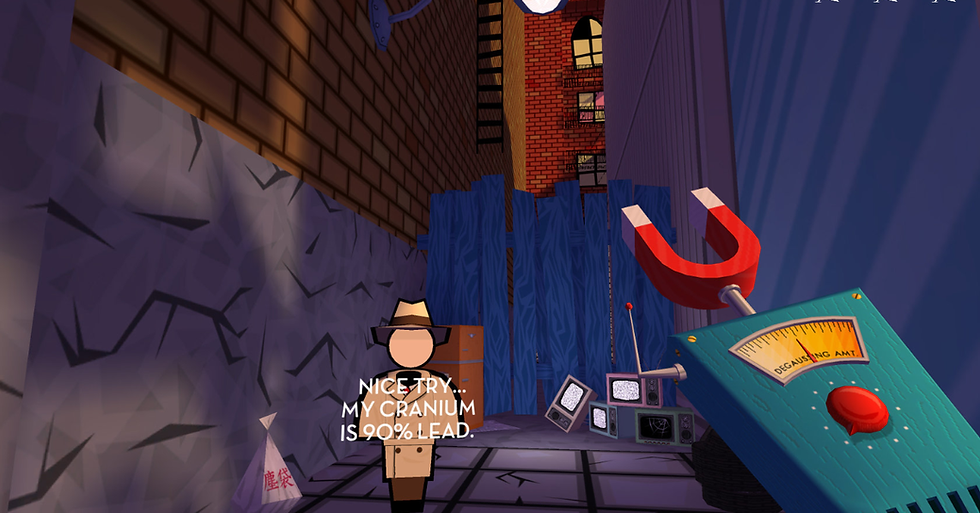
Jazzpunk is a comedy adventure game set in a retro-futuristic Cold War world. Its humour is heavy on visuals, which makes its animation technique inseparable from the core identity. This game stands out for its cel-shaded 3D animation, which gives 3D models a hand-drawn, 2D appearance, creating a retro, visually engaging experience. Its introductory cutscene combines Saul Bass-inspired design with Cowboy Bebop aesthetics while maintaining a cohesive artistic direction throughout.
This type of mixed-media animation is surreal and retro-futuristic in style, and it carries through the rest of the game. For animation students, it’s worth studying how a consistent visual language built through animation alone can define a game’s entire personality from the first frame.
Animation methods that modern games use usually include motion capture, 3D animation, and 2D sprite animations, just to name a few. The role this has in video games could range from essential features like character movements to supplementary details like environmental animations and object responses. Animation can be used in order to improve immersion, storytelling, and dynamics.
Frequently Asked Questions (FAQs)
Is stop-motion possible to do in games?
Yes, it is possible. While the craft is taxing, stop-motion creates a tactile, handcrafted quality for players to immerse themselves in its world in a way digital animation rarely replicates. Games like Harold Halibut and Papetura are strong examples of using stop-motion animation in their gameplay.
What are the other animation styles that games use?
Hand-painted animation styles are also used in video games. It’s almost unthinkable to develop a game with such traditional techniques, but the game Cuphead proved that it is not impossible. Each frame was hand-drawn on paper, inked, and painted and then digitised in Photoshop (post-processing). It creates an immersive experience of the golden age of American animation in its gameplay.
Author's Bio
The TESSR Editorial Team is a collective of creatives and project management practitioners who enjoy sharing real-life experience on project management, creative workflows, and well-being in the creative industries. The team wants to help creative leaders, project managers, and individuals in animation, design, and creative studios understand the benefits of project management. So, creatives can all create with more freedom and, together, build a more sustainable creative culture.
Check out their LinkedIn page here.


Comments