One Last Shot, One Very Malaysian Game: The Story of Kooeh

The cosy genre is like that quiet, wallflower friend who sits in the corner minding their own business. It's always there, just not as noticeable. For years, this niche genre was sidelined and overshadowed by bigger, faster-paced genres that dominated the headlines and sales charts. Today, the genre alone has grown into one of gaming's largest success stories, with its market valued at roughly $973 million in 2024 and projected to grow to $1.4 billion by 2032.
The growth is no coincidence, as more players are turning to games for comfort rather than competition. Cosy games provide an avenue for people to unwind, slow down, and decompress instead of another thing to stress over.
Kooeh: A Timeless Delight arrived right in the middle of that boom, and it was no accident either. The team behind it knew cosy management games were always in demand. So they built around that certainty before committing their last available resources to it.
That certainty paid off in many ways.
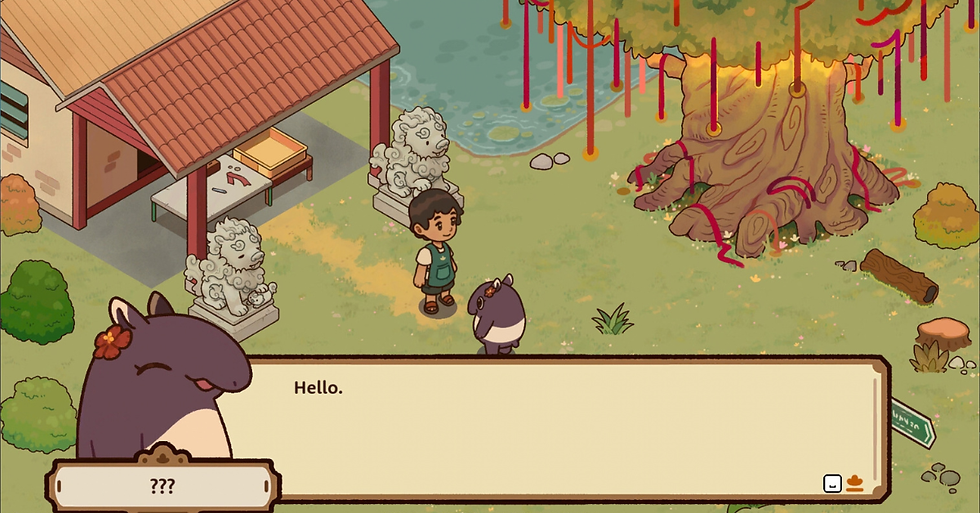
Kooeh is a cosy, narrative-driven restaurant management game about a 20-something white-collar worker who returns to their hometown to revive their family's restaurant. On the surface, it has all the genre's familiar comforts — gentle pacing, warm art, and low stakes. Then they added an element that is under-represented in the market — Peranakan culture and local Malaysian kuihs.
Behind Kooeh is Twilight Foundry Games, a Penang-based studio from Malaysia releasing their first commercial title with this game. Long before Kooeh existed, though, this team had already been through a journey of their own.
A Decade of Many Hats Before Finding His Calling
Every studio has an origin story. Some began with a bold idea, and some had a plan. For Twilight Foundry Games, their beginnings came from a decade of searching and a layoff that kickstarted their entire journey.
TESSR: Tell us a bit about your studio and your team.
William: We were ex-colleagues in a game cinematic company prior to establishing Twilight Foundry Games. It was 2021, and I was leading a team for the company's new business division when we got laid off because our project was cancelled. While the severance benefit was generous, personally I was at a crossroads in my career. Unlike the stereotypical career meta progression, I started late in the industry. But like every naive youngling, I have always been enticed by the idea of starting my own studio and being my own boss.
It's been 10 years since then. If you tell the younger me that I'd be running my own studio now, I'd just smile at you as if you belonged in the mental institution. :'D
Personally, I've had the luxury to wear many hats throughout my decade-old career; from starting as an intern at Lemon Sky as a project coordinator, to being a QA tester and customer service before transitioning into a game designer for Kurechii, to dipping my knees in the world of bizdev at Persona Theory Games (yes, that studio) where I found my calling, to leading production for a mid-sized team before we got laid off. Safe to say that I have meddled in almost every aspect of game development aside from actually touching development, like artists or programmers!
Our team members were involved in games like Passion Republic Games' Gigabash, Nimbus Games' Chiyo, Kurechii's Postknight and King's League II, and more that are sealed behind NDAs.
Between William's own decade-old winding path and a team with experience working on bigger titles, the studio had no shortage of talent, skill, or experience. What they lacked at the beginning was a project of their own that worked.
One Shot Left and They Made it Count

By the time Kooeh came along, two earlier projects had already used up most of Twilight Foundry Games' budget. Sunset Satellite and KopiCat were ambitious ideas from a young studio still figuring out how to execute them, and both fell short. With their limited resources, there was no room left for this third attempt to fail.
TESSR: Tell us the story behind how the game came to be. What first sparked the idea and what made you decide to go all in?
William: The inception of Kooeh was kind of a funny story to me. Before Kooeh, we did Sunset Satellite and KopiCat; two games fell off production and became R&D projects because 1) we were super naive as we just started and 2) there was a lack of high-level direction for the projects. Kooeh was the last project that we could afford at that time since we'd burned through our budget for the previous two projects, so it was sort of a do-or-die situation for us.
The more we brainstormed, the more solid the idea formed. We tapped into what was available for us and what our team's skill set could do. Being based in Penang and looking at the market trends, we knew that cosy management games are always in demand since the lifecycle of each game is quite short. We also knew there was no mention of our local kuihs, nor were there any Peranakan representations. Some of our team members (and I) had some Peranakan background, so we decided that it's an interesting idea to merge everything. From then on, Kooeh was born.
The name Kooeh started off as a project name because we just needed a name for the project folder based on what we already knew. The more we used the name, the more it stuck to us lol. At that time, our team was physically based in Penang, so getting research material is as easy as going downstairs from our apartment!
With the concept taking shape, the next step was simple: see how the public eye would respond.
TESSR: Imagine someone playing Kooeh for the first time. What do you hope they're feeling or thinking while they're actually playing it?
William: Familiarity and cultural relevance. When we first announced Kooeh to the public, we were able to observe the reaction on social media. People loved the art, the Tapir design, and the cosy gameplay akin to Restaurant City (iykyk). We validated the idea a few more times by posting key art and fake screenshots just to make sure it wasn't a one-time thing. Every screenshot also showed different aspects of the game so we got reactions to validate our game systems. It was definitely a great morale boost, and that was also what convinced us we were on the right track.
The Bait-and-Hook and the 3 AM Doubts

Getting players to notice and stay with Kooeh was a challenge. For William and the team, solving that meant they needed to make calculated choices.
TESSR: From a game design perspective, what’s the most important thing you’re trying to get right in this game and why?
William: We knew the unfortunate fact that local players don't really consume local content, so we designed the game to appeal to the global audience instead because there's no point in keeping our options limited. What we did was to introduce Kooeh as a cosy restaurant management game first and cultural elements second. This goes back to the familiarity and relevance as part of our core pillars when making design decisions. It's a simple bait-and-hook strategy.
Some choices stayed true to what they valued most; others had to meet with the harsh reality of what the studio could afford in time and money.
TESSR: What gameplay systems, mechanics, or ideas did you decide to cut out or simplify? What made you realise they weren't serving the game anymore?
William: There were plenty of mechanics and systems that were cut as we developed the game. Kooeh is considered our studio's debut game; a first commercial project. So we had to treat it as realistically as possible. The cut wasn't because it didn't fit the game, but it was due to time and resource constraints. Building the systems would mean research, design, implementation, and testing; each step consumes monetary resources which we didn't have. The restaurant management gameplay system was also relatively new to us, so we were only able to guesstimate our schedule at best. There were gameplay systems like Cleanup and Cleanliness Rating, Delivery System, and better shop customisation that were eventually simplified or cut in the end.
Making those calls is tough. According to William, it is extremely and always tough. Even more so when a feature he knew would have added real value still had to be cut, simply because their budget and time could not stretch as far as needed. "It's a sacrifice we had to make and pay for the repercussions down the road," said William.

When asked whether anything that made it into the game still felt uncertain, the answer was no. Every feature implementation into Kooeh was intentional. If anything, his only regret was not having more time and expertise to properly test and balance what they had already built. As William puts it, "Economics is definitely a very important skill set to have!"
TESSR: What is your personal favourite feature or mechanic that made it into the game? And why?
William: Shop customisation. While it is not perfect or complete, I'm proud it's in because it was my first time designing a complex system. Only God knows how many times I doubted myself at 3 AM when making design decisions. :')
Self-Funding and Running on Fumes
Building Kooeh was both a creative and financial challenge. The team had no publishers or investors to fall back on when the going got tough.
TESSR: I read in Slime Press that you started Kooeh largely through self-funding. What was that journey like for you and the team?
William: Looking back, I think the stars miraculously aligned for us because I was also very surprised that funding was smoother than I thought. Sure, the journey was tumultuous and not for the weak-hearted. At one point, there was so much friction between leadership and the juniors that it resulted in an unclean break between us because of funding issues. But when one door closes, another one opens. I realised that timing is also a very important factor. The whole journey taught me to play my cards right.
TESSR: Knowing what you know now, if you could go back to the beginning of development, is there anything you would do differently?
William: Probably not multitask too hard. The design direction suffered because I was also running the operations and strategy for the studio on a higher level. Some of us were working on outsourcing projects to generate cash flow so we could sustain the development of Kooeh. That means while designing and directing the game, I was also running the daily administrative operations of the studio and business development to us signed for more outsource projects so we could generate more funds.
Every hour spent stretched thin was a hard lesson in disguise. But despite it all, Kooeh made it through, and so did the Twilight Foundry Games team.
Serving Up Diversity and Unity

Kooeh's charm comes through in its cosy pacing and warm art. Its deeper message is something William built into every layer of the game.
TESSR: After the players finished playing Kooeh, what do you hope they understand about the game that they might not have understood when they first started playing?
William: Kooeh's worldbuilding wasn't a core experience that we were particularly focused on. It's shallow and simple enough to understand, and especially relatable if you're from the Southeast Asia region. Most of the storytelling stemmed from personal experience and what we understood from reading the news. The main thing I was striving for was the sense of diversity and unity, a very Malaysian plotline, I'd say, haha.
I just hope that they liked the art and the game as a whole.
Bootstrapping in any case is never for the faint of heart. From someone who has lived through it, here is what William offered when asked what advice he would give to other developers hoping to do the same with their own indie projects.
TESSR: Lastly, after everything you've learned throughout the development of Kooeh, what advice would you give to aspiring game developers who are bootstrapping their own indie projects?
William: A small, well-packaged experience is far superior to a big game. Always be realistic and honest about yourself and the available resources. Think sustainability first before anything unless you are a hobbyist. Be a sponge. Most importantly, enjoy the journey!
Kooeh: A Timeless Delight is out now on Steam, following its debut launch on 17th June 2026. Ready to get your kuih on? Give the demo a try, and if you’re hungry for more, the full game is waiting for you.
Author Bio
Alison Chai is a marketer at TESSR, an artist, and a gaming creator with a finance background. She enjoys exploring the intersections of creative work, structure, and mental well-being. Drawn to the idea of "organised chaos”, she believes that the right systems can elevate creative expression rather than limit it. Connect with her on LinkedIn.


Comments