Best Claymation Movies of All Time Every Animation Fan Should Watch

Table of Contents
Claymation Movies to Watch Out For in 2026 Conclusion Frequently Asked Questions (FAQs) Author's Bio
Introduction to Claymation
Claymation is a type of stop-motion animation that uses clay models as its primary subjects. Animators move each model in small increments, then capture a photograph. Animators repeat this process thousands of times. When those images are played back in sequence, the characters appear to move in natural, fluid motion.
Claymation has a charm that no other animation style can easily recreate. Every character, prop, and expression is shaped by hand, with artists making small adjustments between each frame to create movement. Many clay characters are built around a wire armature to give animators a flexible internal structure they can pose and reposition throughout a shot.
While all claymation is stop-motion animation, not all stop-motion films use clay. Some productions rely on articulated puppets, paper cut-outs, or everyday objects instead. Claymation only represents one creative approach within the broader world of stop-motion animation.
A Brief History of Claymation
Claymation started taking shape in the early 1900s, with the legendary Fun In A Bakery Shop by Edwin S. Porter. This short features a baker sculpting dough into various faces, including recognisable caricatures of figures like Buffalo Bill and Admiral Schley.
The wider public only noticed it when Will Vinton trademarked the word "Claymation" and built a studio around it. From Edwin S. Porter's abandoned clay animation experiments and Georges Méliès's accidental discovery of stop-motion, claymation became a real medium in the industry when Vinton realised its potential. His California Raisins campaign made clay animation famous by the 1980s.
As public interest grew, studios began pushing the medium even further. In Bristol, Peter Lord and David Sproxton founded Aardman Animations, a studio that would become synonymous with clay animation.
Not long after, a young animator named Nick Park joined the team. His graduate film, A Grand Day Out, introduced an eccentric inventor and his loyal dog, Wallace and Gromit. Their humour, expressive animation, and distinctly British charm helped define modern claymation and cemented Aardman's reputation as one of the most influential animation studios in the world.
Read more: 5 Early Animations: A Trip Back in Time
Recommended Claymation Classics and Modern Favourites
Every film on this list brings something different to the table. Some became milestones in animation history, while others introduced new production techniques or unforgettable characters. To help you find your next watch, here's a quick reference.
Film | Release Year | Studio | Streaming Availability* | Standout Detail |
A Grand Day Out | 1989 | Aardman Animations | BBC iPlayer, Prime Video (varies) | Introduced Wallace & Gromit and established Aardman's signature style |
The Adventures of Mark Twain | 1985 | Will Vinton Studios | Prime Video, Apple TV (varies) | Often recognised as the first feature-length clay animation film |
A Town Called Panic | 2009 | Panique! | Kanopy, Apple TV (varies) | First stop-motion film screened at the Cannes Film Festival |
ParaNorman | 2012 | LAIKA | Netflix, Prime Video (varies) | First stop-motion feature to use full-colour 3D-printed faces |
The House | 2022 | Netflix | Netflix | Anthology film created by three different stop-motion teams |
A Grand Day Out (1989)

Production: Aardman Animations, National Film and Television School (NFTS)
Release Date: December 24, 1990
Genre: Animation, Comedy, Family
Country of Origin: United Kingdom
Director: Nick Park
Rated: G
Streaming Availability: BBC iPlayer, Amazon Prime Video (varies by region)
In the story, Wallace and Gromit run out of cheese, so they do what any sensible duo would: build a rocket and fly to the moon to get more. The plot is simple, almost silly. But the real magic is in what you can already see taking shape. Gromit's deadpan expressions, the cluttered workshop, and the slow, thoughtful comic timing are all there from the beginning. These little details became the foundation of Aardman's signature style, one that the studio would continue refining over the next thirty years.
The short earned an Academy Award nomination for Best Animated Short Film and won the BAFTA in that category, and it introduced the world to Wallace and Gromit, who went on to become one of Aardman's most successful franchises.
The Adventures of Mark Twain (1958)

Production: Will Vinton Production, Harbour Towns, Atlantic
Release Date: March 1, 1985
Genre: Animation, Fantasy, Adventure
Country of Origin: United States
Director: Will Vinton
Rated: G
Streaming Availability: Prime Video, Apple TV (varies by region)
Tom Sawyer, Huck Finn, and Becky Thatcher sneak aboard an airship piloted by Mark Twain himself, only to learn he plans to crash it into Halley's Comet on purpose. That setup carries the film through a string of vignettes pulled from Twain's own stories, including a genuinely eerie "Mysterious Stranger" segment that still catches new viewers off guard.
As this film is often recognised as the first fully clay-animated feature film, it demonstrated that the medium could sustain a complex story while maintaining the handcrafted charm that made claymation unique. Will Vinton's small crew also built a new motorised rig for this production, replacing the old hand-cranked system and giving animators far steadier control over each tiny movement. The result still looks smooth for a film made nearly forty years ago.
A Town Called Panic (2009)
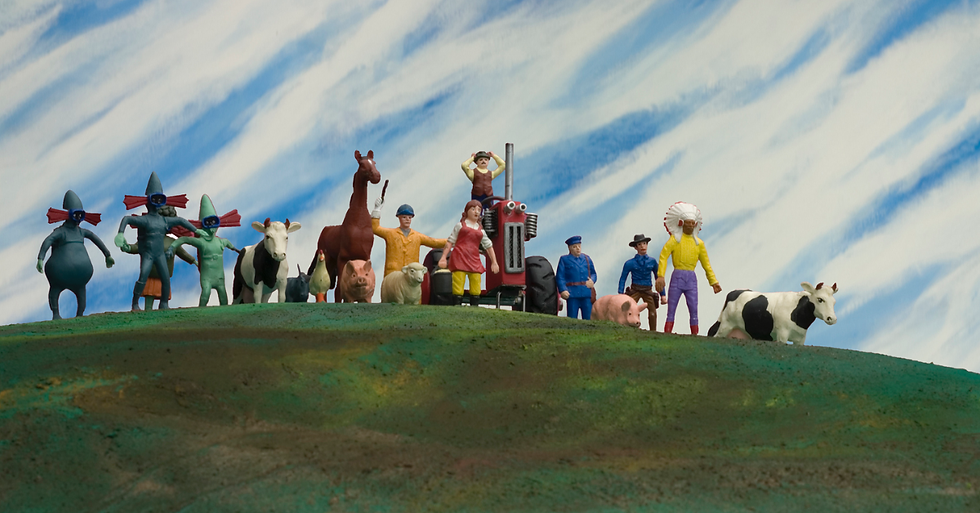
Production: Belgian/French/Luxembourg co-production (La Parti Productions, Beast Animation, Gébéka Films, and others)
Release Date: June 17, 2009
Genre: Adventure, Animation, Comedy, Fantasy
Country of Origin: Belgium, France, Luxembourg
Director: Stéphane Aubier, Vincent Patar
Rated: PG
Streaming Availability: Kanopy, Apple TV
Three plastic toys carry the entire film: Horse, Cowboy, and Indian. Aubier and Patar never try to hide that they are toys. They stand on small plastic bases because real toy figures can't balance on their own, and instead of disguising that limitation, the directors turn it into part of the comedy. Over 260 days of filming outside Brussels, the crew brought the story to life using around 1,500 toy figures.
Adapted from a Belgian TV series, it became the first stop-motion film ever screened at the Cannes Film Festival and went on to win an audience award at Fantastic Fest, a fitting reception for a film built almost entirely on manic, improvised-feeling energy.
ParaNorman (2012)

Production: LAIKA
Release Date: August 17, 2012
Genre: Animation, Comedy, Dark Fantasy, Horror
Country of Origin: United States
Director: Chris Butler, Sam Fell
Rated: PG
Streaming Availability: Netflix, Prime Video
Norman is a misunderstood boy who can speak with ghosts. One day, he fails to prevent a centuries-old witch's curse, raising an army of long-dead zombies. To save everyone, he must stop fighting the monsters and instead use empathy to heal the tragic trauma of a scared little girl from the past.
ParaNorman took a different route, building a story around grief, fear, and social exclusion, then wrapping it inside a zombie comedy with vengeful witches and a centuries-old curse. LAIKA uses 3D-printed facial pieces to pull that balance off, producing thousands of swappable expressions for Norman alone, a method that allowed animators to capture more natural, subtle acting than older replacement-face methods allow.
The film earned an Academy Award nomination for Best Animated Feature, a BAFTA nomination, and two Annie Award wins for character animation and character design, recognition that matches just how alive it still feels today.
The House (2022)

Production: Nexus Studios, Netflix
Release Date: January 14, 2022
Genre: Animation, Comedy, Mystery, Psychological Horror
Country of Origin: United Kingdom
Directors: Emma De Swaef & Marc James Roels, Niki Lindroth von Bahr, Paloma Baeza
Rated: TV-MA
Streaming Availability: Netflix
Set across different eras, The House brings together three separate creative teams to craft three unconnected stories. Each story has its own visual identity, shaped entirely by the team behind it. Felted wool gives the first story an eerie, handmade-doll feel, while the second uses sharper, modern character design and follows a property flip that spirals into a rat problem. The third drops the house into a flooded, near-future world.
The film won an Emmy for Outstanding Individual Achievement in Animation and picked up multiple Annie Award nominations along the way.
Claymation Movies to Watch Out For in 2026

Stop-motion films are a true labour of love, often taking years to move from early development to the finished film. In 2026, two major releases are bringing fresh stories and techniques to the medium.
Wildwood

Studio: LAIKA
Expected Release: October 2026
Director: Travis Knight
A headstrong teenage girl ventures into a hidden forest to rescue her little brother, uncovering a magical world filled with talking animals, mysterious creatures driven by grief and ambition, and an ancient conflict that could change everything. Development on Wildwood began more than a decade ago, making it one of LAIKA's longest-running projects. The film also marks the studio's first feature since Missing Link and showcases some of its most ambitious stop-motion work to date.
Shaun the Sheep: The Beast of Mossy Bottom

Studio: Aardman Animations
Expected Release: September 2026
Directors: Steve Cox & Matthew Walker
When the clumsy Farmer accidentally destroys the flock's pumpkin patch on Halloween Eve, Shaun turns to science to grow new pumpkins before the celebrations. But the experiment goes wrong, leaving a wild beast roaming the woods and the Farmer mysteriously missing. Aardman returns to one of its most beloved franchises with a playful horror-comedy twist. The film continues the studio's tradition of combining meticulous stop-motion craftsmanship with humour that appeals to both children and adults.
Conclusion
What connects these five films across five decades is the human touch in every frame. That tactile quality feels special today, as more animation is created entirely on digital screens. Yet whether you start with the simplicity of A Grand Day Out or the handcrafted textures of The House, the appeal of stop-motion becomes clear. Every movement is carefully built by hand, one frame at a time, making it one of the most time-intensive forms of animation. In a world where fewer studios still create films this way, that dedication is exactly what makes these stories worth celebrating.
Managing a stop-motion production takes more than creative talent. See how TESSR helps animation studios organise projects, streamline collaboration, and keep productions moving forward.
Frequently Asked Questions (FAQs)
What's the difference between claymation and stop-motion movies?
Stop-motion is a broad technique. It means photographing real objects frame by frame to create movement. Claymation is one type of stop-motion that uses clay or plasticine. Puppet animation, cutout animation, and pixilation (using real people) are also part of the stop-motion family, just built from different materials. The terms get used interchangeably in everyday conversation, which is understandable given how similar the results look.
Is The Nightmare Before Christmas a claymation film?
Not exactly. While many people describe it as a claymation movie, The Nightmare Before Christmas is actually a stop-motion puppet film. The characters were built around metal armatures, which are internal skeletons that allow animators to move them in tiny increments between shots. Instead of reshaping clay faces, the production team swapped thousands of pre-made heads and facial pieces to create different expressions.
What's the highest-grossing claymation movie?
Chicken Run (2000) remains the highest-grossing claymation film ever made. Produced by Aardman Animations and DreamWorks, the film earned more than US$224 million worldwide and became a landmark moment for stop-motion animation. Its commercial success proved that claymation could compete with major animated releases at the global box office.
Author’s Bio
With a background in travel and lifestyle storytelling, Farah enjoys turning everyday overwhelm into something a little softer, a little funnier, and a lot more human. She believes in building habits that actually stick (most days), romanticising productivity just enough to survive it, and finding meaning in the mess in between. Currently based in Malaysia, Farah continues to explore writing as both a craft and a coping mechanism, working as a creative writer at TESSR. To know more about her, check out her LinkedIn.

Comments